



When Did Subaru Start Using CVT?
If you’re shopping for a Subaru or already own one, you’ve probably heard about CVT. This transmission technology has become synonymous with the brand’s modern vehicles, but its history with Subaru spans several decades. Understanding when Subaru started using CVT and how the technology evolved helps you appreciate what makes these transmissions unique. Whether you’re curious about what CVT in Subaru means or wondering why Subaru uses CVT instead of traditional automatics, this guide walks you through everything you need to know about Subaru’s journey with continuously variable transmissions.
When Did Subaru First Introduce CVT Technology?
Subaru’s relationship with CVT began in 1989 with the Subaru Justy, a compact vehicle designed for efficiency. This early ECVT (Electro-Continuously Variable Transmission) showed Subaru’s willingness to embrace innovative engineering solutions, though the system proved unreliable at high mileage. This early experiment gave Subaru engineers valuable insights into CVT design and reliability challenges that would inform future development.
The modern chapter of Subaru CVT history really begins in 2010. That’s when the company introduced its refined Lineartronic CVT in the fifth-generation Legacy, marking a pivotal transformation in transmission strategy. Unlike the problematic Justy system, the Lineartronic represented a completely redesigned approach with enhanced durability, better performance characteristics, and improved fuel economy. This patient approach to development reflects Subaru’s commitment to engineering excellence rather than rushing unproven technology to market.
Why Subaru Chose CVT Over Traditional Automatics
Subaru’s decision to embrace CVT technology stems from three key advantages that align with the brand’s engineering philosophy. First, CVT transmissions experience less wear and tear than conventional automatics. The absence of fixed gear changes reduces mechanical stress on components, contributing to longer transmission life when properly maintained.
Second, CVT provides better linear acceleration and performance through seamless power delivery. Rather than the stepped gear changes in traditional automatics, a Subaru continuously variable transmission keeps the engine in its power sweet spot, delivering consistent acceleration without shift points. When you press the accelerator, the CVT maintains optimal RPMs for any driving situation, creating a more refined driving experience.
Third, the technology delivers better fuel efficiency with lower emissions. By keeping the engine at ideal RPMs during acceleration and cruising, CVT transmissions extract maximum efficiency from every drop of fuel. The 2014 Forester demonstrated this advantage clearly, achieving a 5 MPG improvement over the previous generation using the same engine. This matters significantly for drivers in Bradenton and Sarasota, where highway commuting and daily driving benefit from improved fuel economy.
The technology also works seamlessly with Subaru’s renowned Symmetrical All-Wheel Drive system, efficiently delivering power to all four wheels to enhance traction and stability on Florida’s occasionally wet roads.
Subaru CVT Timeline: From 2010 to Today
Early Adoption: Legacy and Outback (2010-2012)
The modern era of Subaru CVT truly began in 2010 when the company introduced Lineartronic CVT as standard equipment in the Legacy and Outback. These flagship models served as the proving ground for the technology, allowing engineers to demonstrate CVT performance across different vehicle types and driving scenarios. Customer feedback from these early adopters helped Subaru fine-tune the transmission’s behavior, calibration, and reliability. The positive reception encouraged the company to expand CVT availability across additional models.
Expansion Across the Lineup (2012-2015)
Building on the success of the Legacy and Outback, Subaru systematically expanded CVT availability from 2012 through 2015. This strategic rollout allowed more customers to experience the efficiency and performance enhancements while giving Subaru time to adapt the transmission for different vehicle weights, engine sizes, and use cases.
The Forester transitioned to CVT in 2014, bringing the technology to Subaru’s best-selling SUV. Each new model year brought incremental improvements in shift feel, throttle response, and durability. This measured approach demonstrated Subaru’s commitment to perfecting the technology before making it universal. Subaru also introduced driving modes with simulated gear steps during this period, addressing concerns from enthusiasts who preferred a more traditional transmission feel.
CVT Becomes Standard Across Subaru Models (2018-Present)
By 2018, CVT technology had become standard equipment in most Subaru models, representing a complete transformation of the brand’s transmission offerings. Today, nearly all automatic Subaru vehicles feature CVT. Manual transmissions remain available only in the WRX, while the BRZ offers either a 6-speed manual or 6-speed automatic, and the all-electric Solterra uses no traditional transmission.
Current models benefit from years of refinement and real-world testing. The transmissions incorporate stronger materials, improved cooling systems, and sophisticated software that adapts to individual driving styles. These enhancements make modern iterations significantly more reliable than earlier versions, giving today’s buyers confidence in the technology’s maturity.
Understanding Subaru’s Lineartronic CVT System
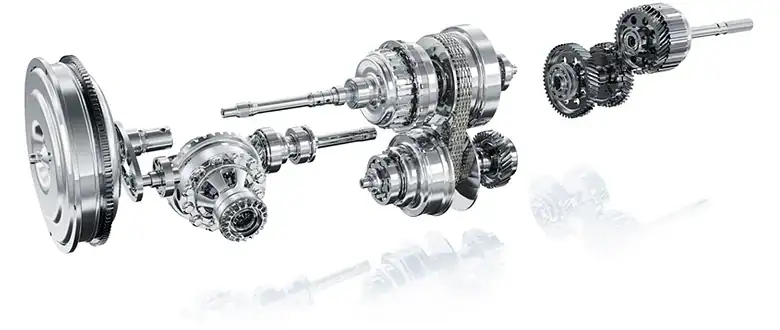
Subaru’s proprietary Lineartronic CVT system represents the culmination of decades of transmission development. Unlike some CVTs that use rubber belts, Subaru Lineartronic employs a robust steel chain connecting two variable-diameter pulleys. This design choice significantly enhances durability and allows the transmission to handle higher torque loads from Subaru’s engines and all-wheel drive system.
As one pulley expands, the other contracts, smoothly varying the gear ratio without distinct shift points. This mechanical solution provides infinite variability within the transmission’s range, allowing the engine to maintain optimal RPMs regardless of vehicle speed or load. The system adapts in real time to driving conditions, seamlessly adjusting ratios to balance performance and efficiency.
Subaru engineers designed the Lineartronic CVT with specific attention to durability. The system includes a reinforced transmission case, new torque converter design, adaptive control, and stepped variable control that provides simulated gear changes when desired. Advanced cooling systems keep the transmission operating at ideal temperatures even during demanding driving. The result is a quieter, smoother driving experience that maintains its characteristics over hundreds of thousands of miles when properly maintained.
Which Subaru Models Have CVT Transmissions Today?
Nearly every Subaru model we sell at Conley Subaru features CVT as standard equipment. The Legacy, Outback, Forester, Crosstrek, and Ascent all come exclusively with Lineartronic CVT when equipped with automatic transmissions. This pairing delivers impressive fuel economy while maintaining the strong performance and handling characteristics Subaru owners expect.
Each application of the Lineartronic CVT gets specifically calibrated for that model’s weight, engine output, and intended use. The Ascent’s CVT, for example, handles the demands of a larger, family-focused SUV while maintaining refinement and efficiency. The Forester balances capability with smooth power delivery ideal for daily driving and weekend adventures.
Only three current models skip the CVT: the BRZ sports car offers a 6-speed manual or 6-speed automatic, the WRX comes with either a 6-speed manual or Subaru Performance Transmission with 8-speed manual mode, and the all-electric Solterra has no traditional transmission. For everyone else, CVT technology enhances the driving experience across Subaru’s diverse lineup.
Are Subaru CVT Transmissions Reliable?
The reliability of Subaru CVT transmissions remains one of the most common questions we hear. Early CVT models in the 2010-2014 range experienced some reliability concerns, particularly related to transmission shuddering and premature wear. These issues led to extended warranties and technical service bulletins from Subaru addressing the problems.
However, modern Subaru CVT reliability has improved dramatically through engineering refinements and design changes. Subaru invested heavily in strengthening CVT components, improving cooling systems, and developing better transmission fluid formulations. Models from 2018 and newer benefit from all these improvements and lessons learned over the previous decade, demonstrating much better long-term reliability when properly maintained.
Regular maintenance plays a crucial role in CVT longevity. Following Subaru’s recommended service intervals, including transmission fluid changes, helps ensure optimal performance and extends the transmission’s lifespan. The certified technicians at our Bradenton service center understand Subaru CVT systems thoroughly and can perform proper maintenance using genuine Subaru parts and fluids designed specifically for these transmissions.
Benefits of Subaru CVT for Florida Drivers
Living and driving in the Bradenton and Sarasota area presents specific conditions where CVT benefits truly shine. The smooth, efficient power delivery reduces driver fatigue during rush hour traffic or when navigating busy streets. The combination of highway commuting, city traffic, and occasional longer trips creates varied driving scenarios that play to CVT strengths.
Fuel efficiency matters significantly for Florida drivers who often face longer distances between destinations. Subaru’s CVT technology helps stretch every tank of gas further, whether you’re commuting for work or taking weekend trips. The transmission keeps the engine at optimal RPMs during highway cruising, delivering impressive fuel economy that translates directly to savings at the pump.
Florida’s warm climate increases air conditioning usage, making CVT fuel efficiency even more valuable. The smooth power delivery also enhances comfort during daily driving, while the transmission’s ability to hold gears when needed provides confidence when merging onto highways. The quiet operation of Subaru’s Lineartronic CVT contributes to a more refined cabin environment, making commutes less stressful and road trips more enjoyable.
Explore Subaru CVT Models at Conley Subaru
At Conley Subaru, we’re proud to serve Bradenton, Sarasota, and the surrounding Gulf Coast communities with a full selection of CVT-equipped Subaru vehicles. We invite you to experience the benefits of Subaru’s CVT system firsthand through test drives of our inventory. Our team can explain how Lineartronic CVT technology enhances each model’s performance characteristics and improves your driving experience.
Beyond sales, our authorized Subaru service center provides comprehensive CVT maintenance using genuine Subaru parts and fluids. Our technicians receive ongoing training on the latest CVT technology, ensuring your transmission receives expert care throughout its lifespan.
Visit us at Conley Subaru to learn more about Subaru CVT models. Contact our team to schedule a test drive and discover which CVT-equipped Subaru fits your lifestyle best.
0 comment(s) so far on When Did Subaru Start Using CVT?